DISCOVER PROJECT
JAKROO
AI Creative Product Suite
Three connected AI applications supporting customer ideation, production artwork preparation, and marketing visualization.
2024 to Present
As AI product lead and hands-on builder, I personally developed and coded three AI-powered applications spanning customer ideation, production artwork preparation, and marketing visualization. The work combines AI product strategy, prompt engineering, multimodal model evaluation, UX design, workflow architecture, and rapid application development.
SERVICES
AI Product Strategy, Generative AI Development, LLM & Multimodal AI, Prompt Engineering, Model Evaluation, AI-Native UX, Human-AI Interaction, Rapid Prototyping, Full-Stack Development, Workflow Architecture, Google Gemini Integration, Systems Integration, Quality Assurance, AI Adoption & Enablement

Project Overview
Build a connected suite of AI-native tools that turns generative and multimodal AI into practical customer, production, and marketing workflows while reducing repetitive work, expanding creative capability, and preserving human oversight.
The AI Creative Suite was developed around three high-value business challenges: helping customers communicate stronger design directions, converting complex generated imagery into usable production assets, and creating professional product visualization without repeated photoshoots or dependence on external imagery. Rather than introducing AI as a standalone feature, I focused on where it could remove friction from existing customer and creative workflows while improving speed, accessibility, and creative possibilities
The project moved generative AI from experimentation into practical, integrated workflows. Three purpose-built applications connect customer concept generation, production artwork extraction, and photorealistic marketing visualization within the broader Jakroo design ecosystem. The suite demonstrates my approach to AI product innovation: identify a meaningful workflow problem, evaluate the right model capabilities, design appropriate human controls, rapidly prototype, test output quality, and integrate the solution where it creates measurable value
Approach

I identified three points in the creative workflow where AI could provide meaningful, repeatable value: customer ideation, production artwork preparation, and marketing visualization. Each use case was evaluated against user need, output quality, workflow impact, technical feasibility, and the level of human control required.
Rather than building isolated AI features, I designed each application as part of a connected system spanning inspiration, production, and presentation. My approach combines hands-on experimentation across LLMs and multimodal AI platforms including Claude, Google Gemini, Grok, and ChatGPT with prompt engineering, workflow analysis, UX prototyping, model evaluation, and application development. Comparing how different models interpret instructions, visual references, context, and constraints has strengthened my ability to match AI capabilities to specific product and business needs.
Process
Each application began with a clearly defined user, workflow problem, desired output, and quality standard. I mapped how customers and internal teams would interact with the AI, then translated complex model capabilities into guided controls, structured prompts, visual references, and predictable workflow steps.
Development followed a rapid cycle of prototyping, prompt iteration, model testing, image evaluation, UX refinement, and system integration. I tested model behavior across different instructions, reference images, products, colors, graphics, and edge cases to identify failure patterns and improve consistency. Human-in-the-loop review remained central throughout the process. Outputs were evaluated for creative quality, garment fidelity, graphic accuracy, production usability, and customer value before successful patterns were translated into repeatable application workflows


The design philosophy is simple: advanced AI should feel useful and controllable, not technically impressive for its own sake. Each experience gives users meaningful ways to direct the output through prompts, references, colors, logos, product selections, and other project-specific inputs. AI accelerates exploration and repetitive production tasks while people retain judgment, creative direction, and final decision-making. This balance between automation and human oversight is central to how I approach AI-native product design
Final Design
The completed suite establishes a connected AI workflow spanning customer inspiration, concept development, production artwork preparation, and marketing visualization. Each application applies generative or multimodal AI to a clearly defined task while maintaining structured user control and human review. Together, the tools turn advanced AI capabilities into practical experiences for customers, designers, production teams, and marketing staff
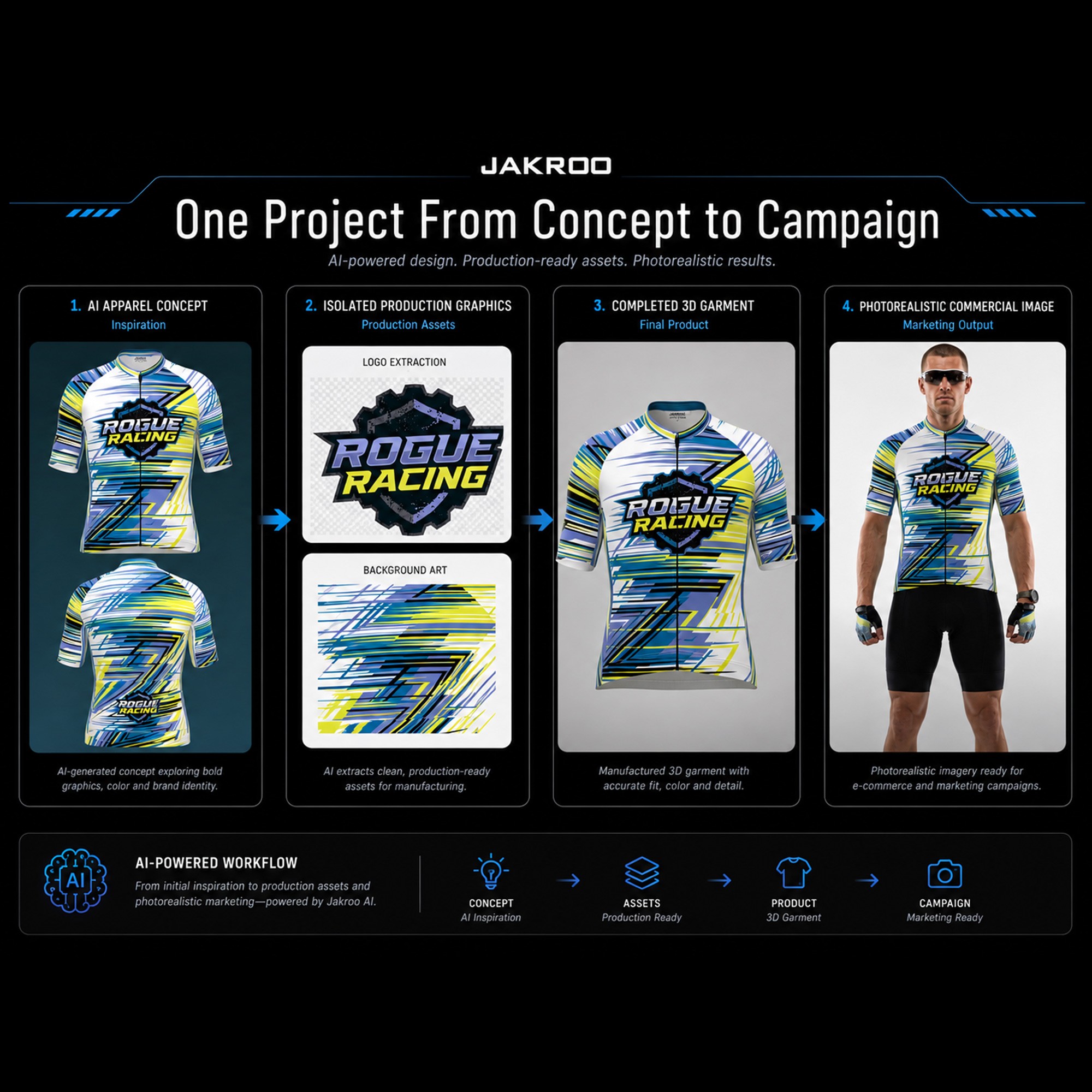
The final product suite consists of three purpose-built AI applications: Idea Generator helps customers translate written direction, product choices, colors, logos, and visual references into multiple apparel concept directions. Artwork Extractor analyzes complex concept imagery and isolates backgrounds, graphics, emblems, textures, and other visual assets for production preparation. Marketing Image Generator transforms completed apparel designs into controlled studio and lifestyle imagery using configurable models, poses, environments, demographics, camera angles, and output formats. Together, the applications connect AI-assisted ideation, asset preparation, and visualization within one broader creative workflow
PROJECT PREVIEW


Achievements
“The AI Creative Suite has made it much easier to move from an early concept to usable design assets. It gives us stronger starting points, helps isolate graphics from complex imagery, and reduces the amount of repetitive preparation needed before production. The tools feel like a natural extension of our workflow and allow us to spend more time refining the design rather than rebuilding assets from scratch.”
Personally developed, coded, tested, and integrated three custom AI applications spanning customer ideation, production artwork preparation, and marketing visualization. The work combined AI product strategy, LLM and multimodal experimentation, prompt engineering, application development, UX design, model evaluation, and workflow integration. The suite introduced practical generative AI directly into existing customer and internal systems while reducing repetitive creative work and expanding access to original visual assets
The project established a scalable framework for identifying, prototyping, evaluating, and deploying AI enhancements across the creative lifecycle. Beyond the three applications themselves, the work strengthened my ability to evaluate emerging models, understand their strengths and limitations, design effective human-AI interactions, and translate rapidly evolving AI capabilities into useful products and operational improvements
Concepts Generated
Faster Production